
Recently, the people and clients I meet have been consistently telling me that their cost of growth is rising year on year. And that is alarming.
The cost of growth is soaring. What happens when the price to win a new customer jumps 50% practically overnight?
Growth marketers in 2026 are finding out. Customer acquisition costs (CAC) have surged by 40–60% since 2023, fueled by fierce competition, privacy changes, and murky attribution. Digital advertising, once a bargain, now eats a lion’s share of budgets. In some cases, 30–40% of a DTC brand’s revenue goes straight to ad spend.
The result? Profit margins shrink, and many companies are seeing red on new customers. It’s gotten so extreme that some brands find it cheaper to mail old-school catalogues than to run Facebook ads. This was a scenario unthinkable just a few years ago.
In this environment, growth at any cost won’t cut it. The game has shifted from “spend and acquire” to “acquire smarter and maximise value.”
How can we survive this shift? It starts by obsessing over the balance between CAC and customer lifetime value (LTV). If you’re paying $100 to acquire a customer who only brings in $80, you’re in trouble.
To stay in the black, LTV needs to beat CAC by a healthy margin. Ideally, this ratio is 3:1 or better. Every dollar spent to get a customer should return at least three dollars in revenue over that customer’s life.
Fast-growing B2C companies can still pull this off amid rising costs. Below, we dive into three strategies for balancing CAC with LTV and achieving smarter growth.

1. The New Reality: CAC Surge Squeezing Profitability
It’s official: acquiring customers is more expensive than ever. We are witnessing a fundamental decoupling of cost and value. Between 2013 and 2021, average acquisition costs skyrocketed so much that brands went from losing $9 on every new customer to losing $29.
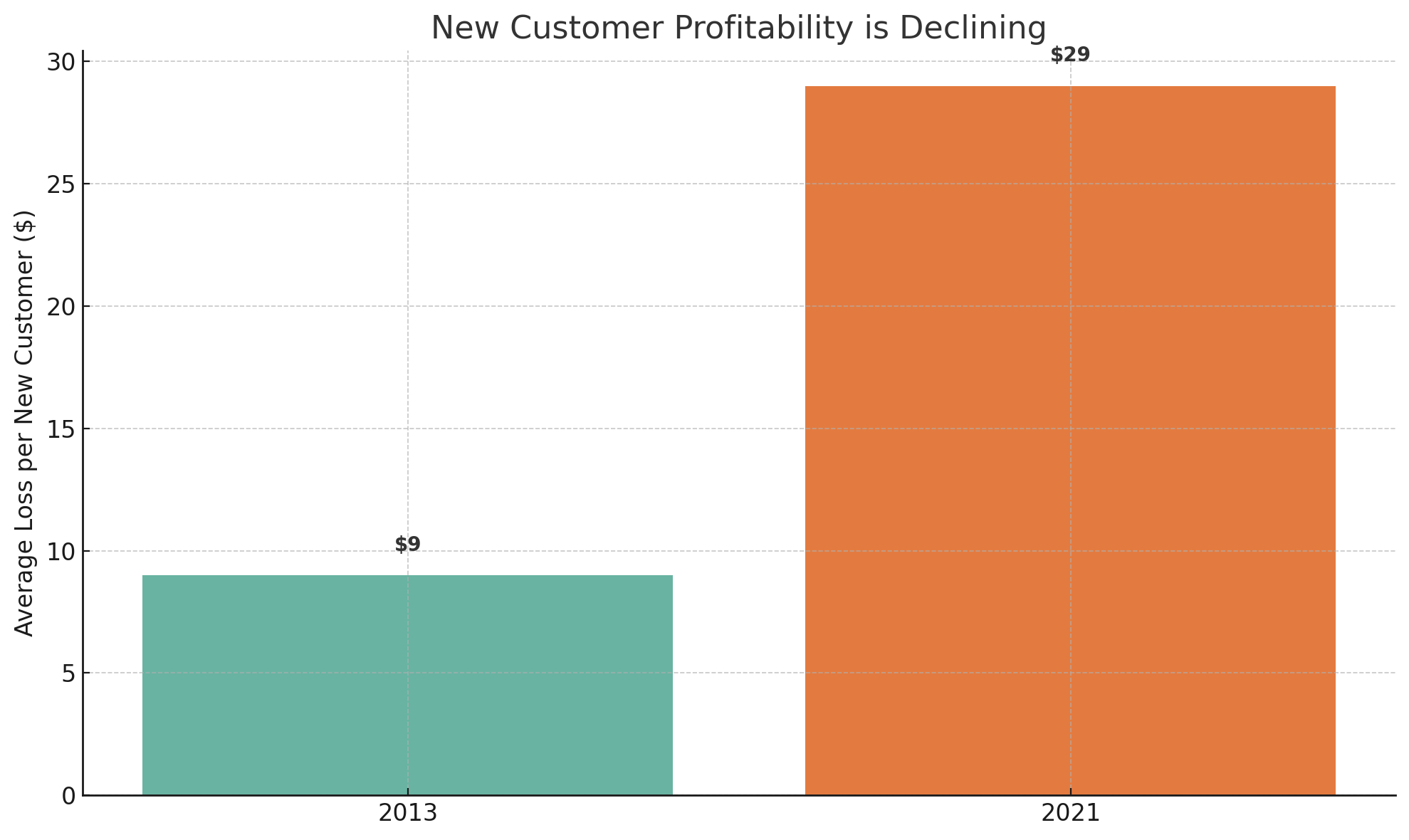
That is a 222% increase in the cost drag, driven almost entirely by higher CAC and friction. In just the last two years, CAC has kept climbing by roughly 50%. We are living through a perfect storm. The precision of targeting has eroded due to privacy shifts, while competition has turned digital auctions into a bloodbath. Facebook’s cost per action has jumped so high that spending $230 to acquire a single customer is no longer an outlier; it is the new baseline.
These rising costs are crushing margins. If you used to pay $50 to get a customer and now pay $80, that extra spend is a direct tax on your survival. Many brands are literally losing money on initial sales. The traditional growth playbook, where flooding the zone with venture-backed ad spend, has hit a wall. To thrive, we must shift from “spend and acquire” to “acquire smarter.”
2. Smarter Acquisition: Cut Costs and Boost Efficiency
When CAC is rising, you cannot afford sloppy spending. You must channel your inner efficiency expert. The first lever of our balancing act is bringing CAC down by squeezing more conversions out of every single dollar.
Prioritise Lower-CAC Channels: Not all channels are created equal. Referral programs and word-of-mouth incentives often deliver customers at a fraction of the cost of paid ads. Content marketing and SEO require upfront effort, but they build an “equity” that makes future customers effectively free.
Optimise Ruthlessly: If you must spend on ads, make them work harder. Use first-party data to tighten targeting and rotate creative to prevent ad fatigue.
Master Conversion Rate Optimisation (CRO): Why pay for 100 clicks to get 5 customers if you can tweak your funnel to get 10? Recent data shows that advertisers focusing on conversion improvements rather than bidding wars are the ones maintaining a healthy CAC.
You cannot control the market price of an impression, but you can control how well you convert that traffic.
3. Maximising Lifetime Value: Keep Customers Coming Back
If rising CAC is the headwind, a higher Customer Lifetime Value (LTV) is the tailwind that offsets it. As Seth Godin might say, stop chasing strangers and start nurturing the ones you’ve already won.
Acquiring a new customer can cost **5–25X more** than retaining an existing one. A happy repeat customer comes “pre-acquired.” You don’t have to pay the “Zuckerberg Tax” twice. In fact, increasing customer retention by just 5% can lift profits by 25%–95%.
To truly maximise LTV, we focus on five battle-tested strategies:
Invest in Experience: Seamless support and fast shipping turn transactions into relationships.
Loyalty & Perks: Programs like Starbucks Rewards cultivate habit-forming loyalty.
Retention Campaigns: Use personalised SMS and email to win back business before a customer churns.
Thoughtful Upselling: Use data to suggest what they actually need, increasing the average order value.
Subscription Models: The “holy grail” of LTV is recurring revenue that locks in repeat value.
Crucially, you must measure your LTV:CAC ratio. Aim for the magic **3:1 ratio** — spend $1 to get $3 back. If your ratio is slipping toward 1:1, it is a red flag that your retention machine is broken. The healthiest growth comes from acquiring the right customers, not just any customers. It is far better to have 1,000 loyal fans than 2,000 one-and-done bargain shoppers.
The Takeaway: Every additional month or purchase you earn from a customer cushions the blow of that initial CAC hit. In 2026, the winners won’t be those with the biggest budgets, but those with the deepest relationships.
Final Thoughts: Growth That Sticks, Not Slick Tricks
Rising acquisition costs are the new gravity. A constant, downward pull on your margins. But gravity doesn’t ground the pilot who understands aerodynamics. The winners in this era won’t be those who simply spend the most on ads; they will be the ones who spend smartly and retain fiercely.
By reining in CAC through efficient, high-signal channels and elevating LTV through customer-centric strategies, you achieve the golden balance. This isn’t just a spreadsheet exercise; it is the only sustainable path to growth.
In practice, this requires a holistic shift. Marketing isn’t about pumping leads into a leaky funnel; it’s about building a base of profitable, loyal fans. Keep your LTV:CAC ratio as your north-star metric. Treat 3:1 as the thin line between a scalable business and an expensive hobby. When that ratio dips, don’t just ask for more budget — cut the CAC waste or amp up your retention efforts.
The cost of maintaining a customer is always less than the cost of winning a new one. The most successful brands understand that acquisition and retention are two sides of the same coin. They acquire smartly, then do everything possible to keep those customers happy for years. That is growth that compounds value rather than eroding it.
The deck is stacked with higher costs, but you can stack the odds back in your favour by maximising what each customer is worth. Those who master this balance will not only survive these turbulent times; they will thrive with unit economics that make profitability and growth two sides of the same success story.
Your Actionable Takeaway: Audit your LTV and CAC today. Where is your ratio? If it’s below 3:1, pick one acquisition expense to cut and one retention play to double down on this quarter. Small tweaks like a refined Google Ads target here, a new loyalty drip there, will move the needle. In a world of rising costs, let smart strategy be your competitive advantage.
Spend wisely, nurture relentlessly, and growth will follow.
Is your LTV:CAC ratio healthy enough for 2026? Reach out and let’s discuss how to rebalance your growth here.