
As someone who used to be in the OTT streaming industry, this one felt personal. When the news broke that Netflix would be purchasing Warner Bros. Discovery for $82.7 billion, it did not feel like just another M&A headline. It felt like a cultural plot twist. One that few would have believed a decade ago, and yet now feels strangely inevitable.
Warner Bros once owned the cultural high ground. HBO was not just TV, it was taste. Subscribing to HBO signalled discernment. It meant The Sopranos, The Wire, Game of Thrones. Prestige you paid for, waited for, and talked about on Monday morning. Which raises the uncomfortable question: how did the studio that defined “premium” end up licensing its crown jewels to Netflix, a company that once mailed DVDs in red envelopes?
This was not a disruption. It was self-inflicted decay, driven by identity confusion, debt-led decision making, and product thinking anchored to a legacy world that no longer existed. This teardown is not about gossip, personalities, or nostalgia. It is about product, incentives, and strategy. A clear-eyed look at how great companies lose the plot quietly, one rational decision at a time. The strategies and alternate paths explored here are a thought experiment, shaped by my own perspective. Not hindsight heroics, but lessons worth stealing before your own final season airs.
1. The Golden Age Moat and Game of Thrones
HBO was a product, not just a channel
For four decades, HBO built one of the strongest moats in modern media. Scarcity. Curation. Cultural moments. From The Sopranos to The Wire to Game of Thrones, HBO trained audiences to associate Sunday night with status. This was appointment viewing in an on-demand world.
HBO was not background noise. It was a signal. Subscribing said something about you. That you valued quality over quantity. That you had taste. This mattered because the brand equity transcended any single show. It justified premium pricing, slower release cycles, and a sense of trust that few media companies ever earn.
In product terms, HBO did what most platforms fail to do. It stood for something clear, narrow, and emotionally resonant.
Game of Thrones was not the problem
The finale did not kill HBO. Dependency did.
The real failure was not a controversial ending but a lack of succession planning. When Game of Thrones ended in 2019, there was no narrative handoff. No next cultural gravity well. Viewers did not migrate en masse to Westworld or Watchmen. They left.
The data tells a blunt story. Post-2019, HBO saw a sharp audience drop. No replacement show achieved comparable cultural pull. This was not market saturation. It was product fragility. When one feature carries the entire value proposition, the product is weaker than it looks.
The lesson is uncomfortable but universal. If your best feature leaves and your users leave with it, you did not build a platform. You built a hit.
2. While Warner Bros Debated, Netflix Compounded
Infrastructure beats prestige
Netflix did not win because it spent the most on content. It won because it built the best systems.
Its advantage was infrastructure. A compounding flywheel that looked like this: more users led to more data, which led to better recommendations, which drove higher engagement, which informed smarter content bets.
Netflix iterated at product speed. Warner Bros moved at board-cycle speed.
Netflix is becoming a utility rather than a channel. That framing matters. Utilities are hard to displace because they embed themselves into daily behaviour. Prestige brands still need to earn attention every time.
When everything is the product, nothing is
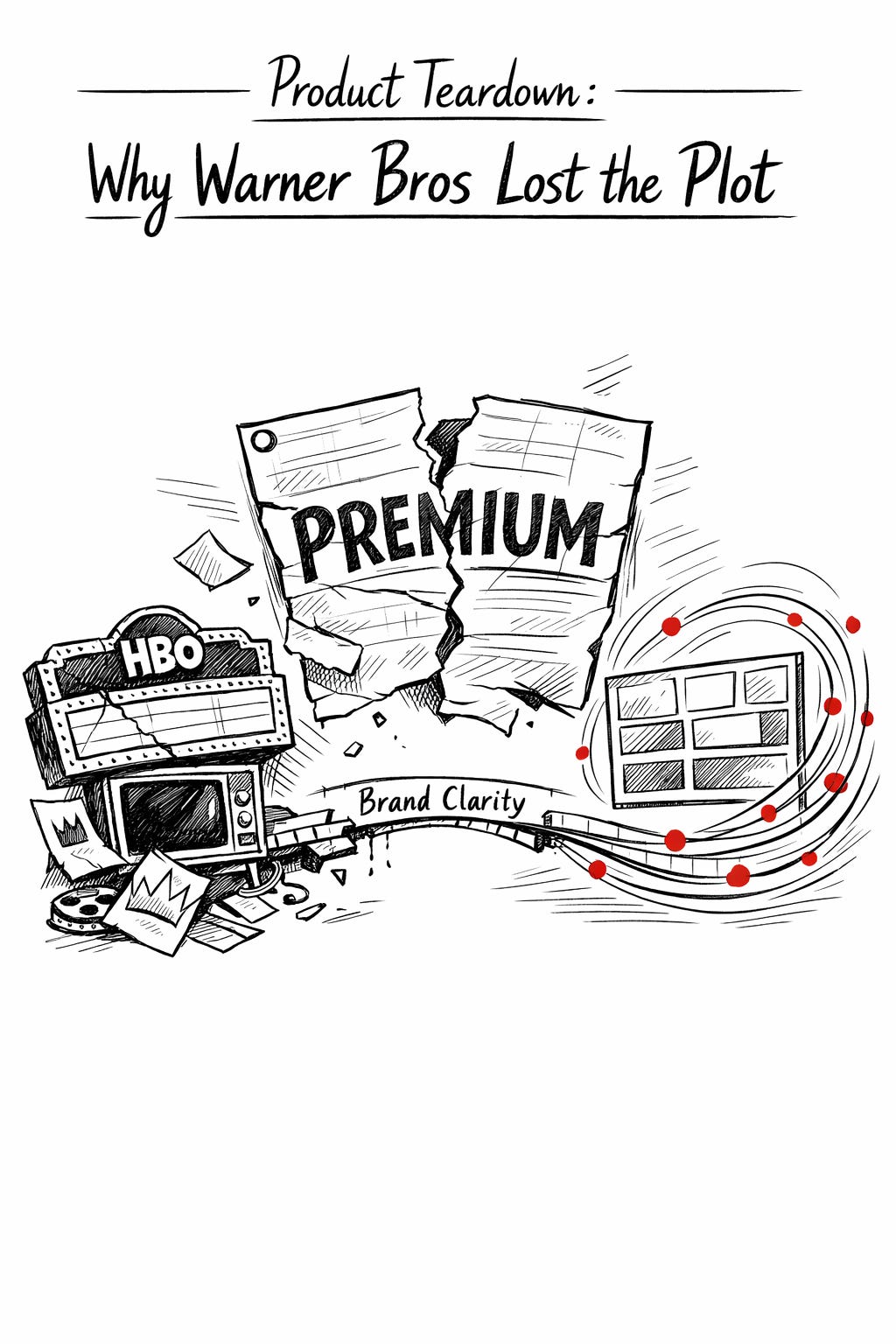
Then came the identity crisis. HBO Max launched. Then it was rebranded to Max. Then, quietly, it became HBO Max again.
Each move was rational in isolation. Together, they were destructive.
Prestige drama sat next to reality TV in the same interface. Discovery content collided with HBO’s carefully cultivated aura. Users no longer knew what the brand stood for.
People buy meaning before features. Warner Bros did not lose features. It erased meaning.
Conflicting business models, one broken experience
Underneath the branding confusion was a deeper structural problem. An impossible triangle.
Theatrical teams wanted exclusive windows. Streaming teams needed immediacy. Finance teams were focused on debt reduction. Project Popcorn, the simultaneous theatrical and streaming release strategy, was not a solution. It was a compromise dressed up as innovation.
The result was predictable. Theater partners were alienated. Creators felt betrayed. Consumers were confused. When everyone is optimised for a different outcome, the product experience suffers quietly and then suddenly.
3. The Alternate Timeline
What Warner Bros could have done
The tragedy is that none of the alternatives were radical.
One path was to become the prestige streaming service. Fewer shows. Higher prices. Clear positioning. Think twelve to fifteen cultural events a year, not a content firehose.
Another was to partner early with a platform player like Apple. Capital on one side, content on the other. HBO is a premium layer, not a mass-market competitor.
A third was to separate from debt faster and reset incentives around customers rather than creditors. Painful in the short term, liberating in the long term.
These were not moonshots. They were uncomfortable choices that required saying no.
The Netflix deal is a symptom, not the ending
Selling content to Netflix signals more than pragmatism. It signals a loss of distribution leverage. In markets where scale wins, late movers do not disappear. They become suppliers.
This is consolidation as inevitability. Fewer platforms. More power. Higher prices. Exactly the oligopoly dynamics Galloway has warned about in the streaming economy.
Warner Bros did not lose because Netflix was brilliant once. Netflix compounded while Warner Bros hesitated. And in product strategy, hesitation is rarely neutral. It is cumulative.
Final Thoughts: Great Companies Rarely Die Loudly
Great companies do not collapse in spectacular fashion. They fade. Quietly. Through a thousand small, reasonable decisions that make sense in the moment and compound into irrelevance over time. Warner Bros did not lose because Netflix made one genius move. They lost because Netflix was consistently clearer about who it was building for, what it stood for, and how fast it needed to move.
This is the uncomfortable product lesson. Speed beats optimisation. Focus beats volume. A brand is not a logo or a legacy. It is a fragile promise renewed every time a customer opens your product and instantly understands why it exists.
Warner Bros did not lose the streaming war. They lost the plot long before the final episode.