
“Just increase the marketing spend.”
“Let’s 10x the leads pipeline.”
“Cut the price. Volume will follow.”
Sound familiar? Over my past 15 years of working with senior leaders, this is what I’ve heard ever so often. And for a season, they feel like strategy.
Then comes the follow-up question, usually six to twelve months later, from the same senior leader who issued the decree: “Why are we still not growing?”
Here’s the uncomfortable truth. Most companies aren’t failing at growth because they lack ambition. They’re failing because they’re treating symptoms while ignoring the disease.
Marketing is spending to fill a leaky bucket. Sales is closing deals that the product can’t deliver. Operations is sprinting to keep up with a pace it was never built for. And leadership is measuring metrics that tell a comfortable story.
Growth doesn’t fail at the campaign level. It fails at the systems level.
The companies that crack sustainable growth share one thing in common. They don’t treat marketing, product, operations, and strategy as separate departments. They treat them as one organism. When one part moves, the rest move with it.
That’s the lens I bring to every engagement. And it’s the only way I know how to build growth that lasts.
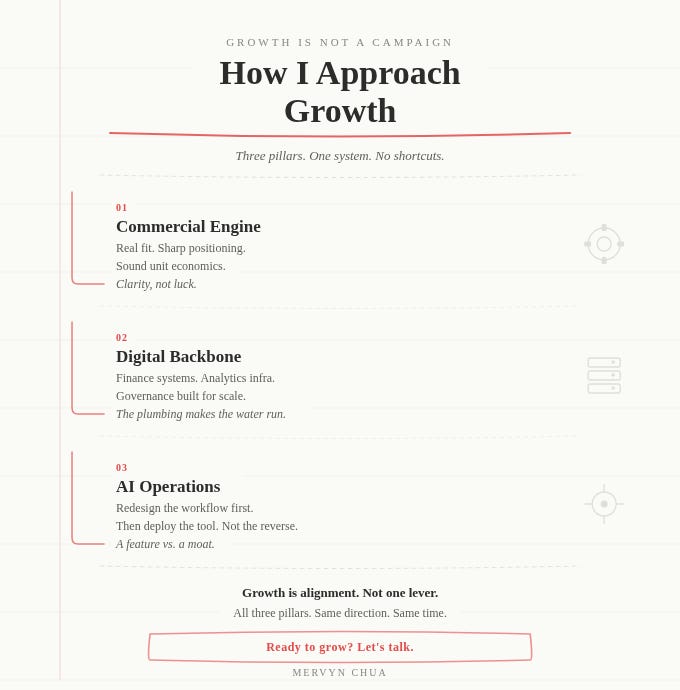
1. Build the Commercial Engine First
Before you scale anything, you need to know what you’re scaling.
Most companies skip this step. They pour fuel into a commercial engine that hasn’t been properly built. They acquire customers into a product that isn’t positioned well. They invest in brand visibility before the unit economics make sense.
The first pillar of my approach is getting the commercial engine right. That means achieving real product-market fit, not assumed fit. It means having clarity on your brand positioning and what value you actually deliver. It means understanding your margins, your payback periods, and your true cost of acquisition.
This isn’t just marketing work. It’s business architecture.
Revenue scalability isn’t a marketing function. It’s a cross-functional output. When your positioning is sharp, your economics are sound, and your acquisition frameworks are built for the right customer, growth stops being a lottery and starts being a system.
Most companies don’t have a customer acquisition problem. They have a clarity problem.
2. Your Digital Backbone Either Carries You or Buries You
Here’s a pattern I’ve seen more times than I care to count.
A company scales. Revenue climbs. Headcount grows. Then, somewhere around the 50 or 100-person mark, everything slows down. Decisions take longer. Reporting is inconsistent. No one agrees on the numbers. The data is everywhere and useful to no one.
The problem isn’t scale. The problem is that the infrastructure was never designed for scale.
The digital backbone of an organisation, its finance systems, reporting layers, data integrations, and governance frameworks, is the unsexy work that determines whether growth creates value or just creates chaos.
Modernising this foundation isn’t a back-office IT project. It’s a strategic decision. Companies that invest in reporting and analytics infrastructure before they need it gain a significant advantage: they can see what’s working, what isn’t, and where to double down. Fast.
Everyone wants the glamour of growth. Few want to do the plumbing. But the plumbing is what makes the water run.
3. AI Is Not a Strategy. Operational Integration Is.
The AI hype cycle has produced one very specific failure mode: companies that deploy AI tools on top of broken processes and wonder why nothing improves.
AI doesn’t fix bad workflows. It accelerates them, for better or worse.
The third pillar of my approach is embedding AI as a genuine operational capability. That means redesigning the workflow before introducing the tool. It means assigning clear ownership for ROI and operational impact. It means integrating AI into the daily processes people actually use, not parking it in a pilot programme that never ships.
The companies winning with AI right now aren’t the ones with the most tools. They’re the ones that treated AI adoption as an operational transformation, not a technology experiment.
There’s a meaningful difference between a business that uses AI and a business that runs on AI. One is a feature. The other is a moat.
Final Thoughts
Growth isn’t a campaign. It isn’t a quarter. It isn’t a headline metric someone presents on a slide deck.
Growth is what happens when commercial strategy, digital infrastructure, and operational capability are all pulling in the same direction, at the same time, with the same information.
Most consultants will improve one of these areas and call it a success. I’m not interested in that trade-off. The three pillars only work because they reinforce each other. A sharper commercial engine needs better data to perform. Better data needs cleaner operational processes to be trustworthy. Smarter operations create the capacity to execute on commercial ambition.
This is the model I use. Not because it’s elegant on paper, but because it’s the only one that builds something durable.
If you’re building a business that’s ready to grow but not sure what’s holding it back, let’s talk.
I work with a small number of companies at a time. That’s intentional. If the work you’re doing matters, it deserves more than a generic playbook.
A note before you close this tab. The fact that you read this far tells me something. You already sense that the way you’ve been thinking about growth might be incomplete. That instinct is worth following.