
A few years ago, my Saturday morning ritual was simple.
Coffee, injury reports, and a dozen Google searches to optimise my Fantasy Premier League lineup. Today, none of that involves Google. Instead, I’m scrolling through TikTok for last-minute injury whispers, wildcard hacks, and highest differential captain picks. Not because I’m trying to be cool, but because the best answers aren’t on search engines anymore. They’re on social feeds.
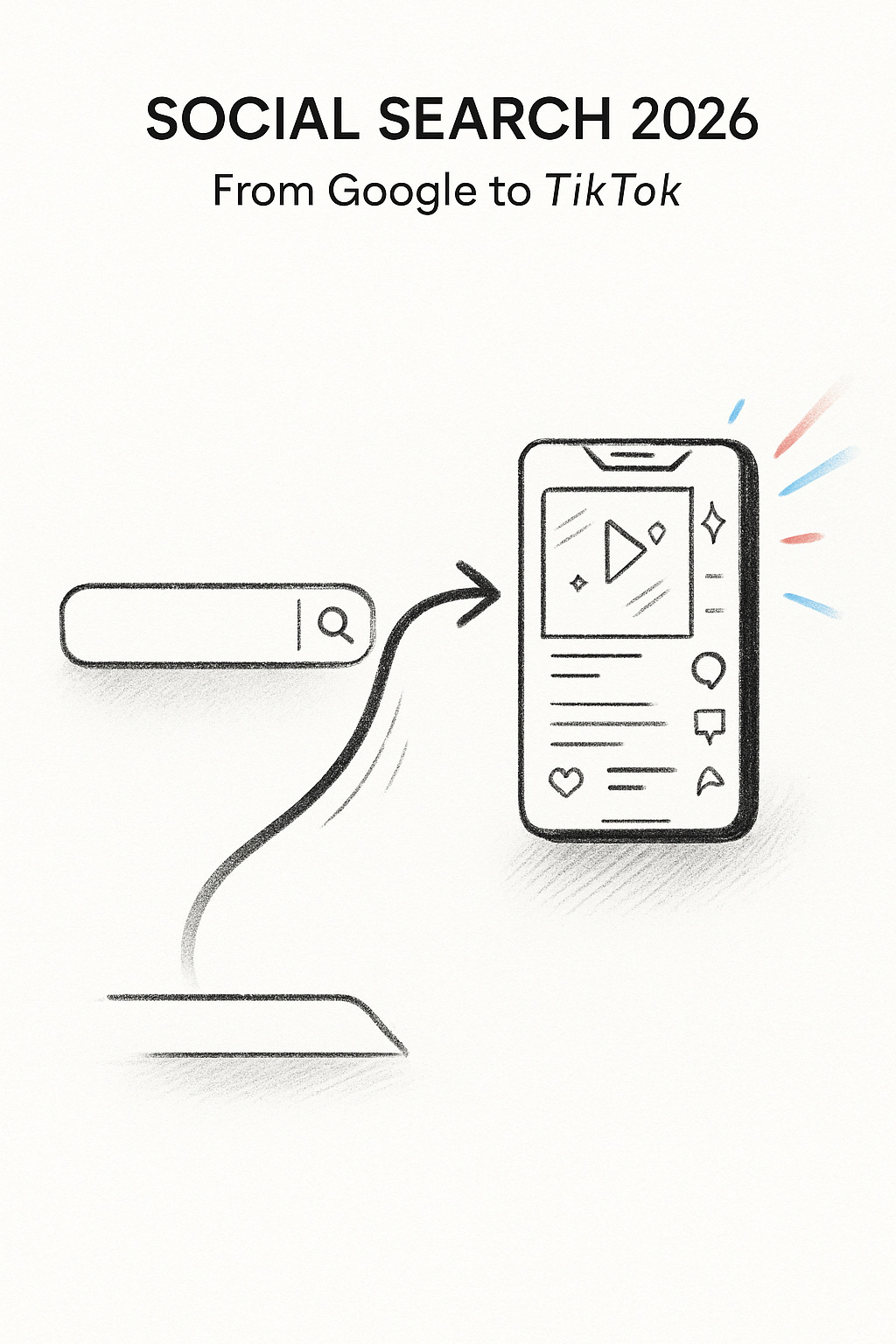
That tiny shift in my routine mirrors a massive shift in global consumer behaviour. Search isn’t dying; it’s relocating. Discovery, intent, and decision-making are no longer triggered by static blue links. They’re being shaped by dynamic short-form videos built by creators and algorithms that learn faster than we do.
This is the rise of social search. And in 2026, it’s no longer a sideshow. It’s the new operating system for consumer discovery, powering a global commerce engine on track to reach almost three trillion dollars.
1. The Great Discovery Migration: Why Search Moved from Google to Social
For years, we treated Google as the front door to the internet. Today, that door is shifting, and most brands haven’t noticed they’re standing in the wrong hallway.
1.1 The economic displacement
The data is blunt. 82% of consumers now use social platforms for product discovery**, with Gen Z leading the shift at 76%. Social commerce in the US is marching toward $150B, while global projections hit $2.9T by 2026. This isn’t a trend curve. It’s a tectonic plate moving under every marketer’s feet.
And here’s the uncomfortable truth: while consumers migrate to TikTok and Instagram for answers, many brands are still optimising like it’s 2015. They’re building for search engines while their customers are discovering through creators, comments, and chaotic-good algorithm magic.
1.2 Intent isn’t just typed anymore
On TikTok, intent is a behaviour, not a query. It shows up in the micro-moments: how long you hover, what you rewind, what you save at 2 AM. These signals whisper more about interest than any typed keyword ever could. Short-form platforms have become intent-discovery engines that don’t wait for you to ask a question; they predict the question before you know you have one.
1.3 What this means for brands
If your brand only appears when someone types into Google, you’re already behind. In 2026, visibility lives in the scroll. If your content doesn’t appear when someone laughs, pauses, shares, or stops mid-swipe, you don’t exist. The algorithm doesn’t care about your domain authority. It cares about whether someone watched your video twice.
2. S-SEO: Social Search Optimisation and the Rise of the Three-Layer Index
For two decades, SEO revolved around one thing: text. Keywords, tags, metadata. In 2026, the universe has expanded. Social search now requires a three-layer indexing strategy that mirrors how platforms actually understand content.
2.1 Layer 1: Textual Signals (Captions, Keywords, Hashtags)
Think of this as the foundation. Captions need natural-language long-tail keywords. Hashtags should stay tight and relevant, ideally three to five. No hashtag stuffing. No keyword salad. Write for humans first, algorithms second.
2.2 Layer 2: Visual Signals (On-screen text)
On-screen text is your new title tag. TikTok and Instagram don’t just show your subtitles. They read them. A clear phrase like “Best moisturiser for oily skin” on screen makes your content discoverable even before a user engages. It’s a scroll-stopper and an indexing cue rolled into one.
2.3 Layer 3: Auditory Signals (Spoken keywords)
Here’s the twist no one saw coming. With near-perfect AI transcription, spoken audio is now a search surface. If you say “budget-friendly running shoes” out loud, TikTok treats it like metadata. The algorithm hears you. Literally. Brands that don’t script spoken keywords into their content are leaving discoverability on the table.
2.4 Velocity Metrics: The New Ranking Factors
In the old world, backlinks built authority. In the new world, velocity builds relevance. Platforms elevate content using metrics that show immediate audience interest:
Watch time
Completion rate
Rewatches
Shares
The For You Page is the new Page One, and the only way in is through content that hooks in three seconds.
3. The Search Horizon: AI, AR, and Zero-Click Commerce
We aren’t just replacing Google. We’re outgrowing it. What’s emerging in 2026 is a search landscape powered by intelligence, personalisation, and frictionless commerce.
3.1 AI-driven hyper-personalisation
AI now orchestrates a dynamic experience for every user. Search results re-rank in real time. Product pages morph based on behaviour. Offers change depending on loyalty, price sensitivity, or previous interactions. This isn’t segmentation. It’s micro-personalisation at scale.
3.2 Visual search as the new discovery engine
TikTok Visual Search lets you find products by pointing your camera. No typing. No guessing. No Google. It’s a discovery without effort and intent without a query. A camera becomes the most intuitive search bar in the world.
3.3 AR as the new trust indicator
AR try-ons bridge the last gap between desire and decision. Want to see how the lipstick shade looks or whether the sneakers match your fit? Try them on instantly. One swipe later, you’re at checkout.
By 2026, discovery, research, and purchase no longer live in separate stages. They happen in one continuous motion, inside one app, powered by one algorithm that knows what you want before you articulate it.
Final Thoughts: The Search Singularity Has Arrived
We’ve crossed a threshold. Search is no longer a destination. It’s a behaviour woven into every swipe, pause, and rewatch.
What started as a small shift in how I choose my Fantasy Premier League captains has become a global reordering of how consumers discover, evaluate, and buy.
To stay visible in 2026, three strategic imperatives matter more than anything else.
1. Master S-SEO
Engineer every piece of content for layered indexability. Text, visuals, and spoken audio must work together as one search-optimised engine. If it isn’t indexable, it isn’t findable.
2. Prioritise authenticity
Trust has become the algorithm. UGC, detailed reviews, and micro-influencers don’t just make your brand relatable. They make it rank.
3. Profitable attention
Traffic is a vanity metric. The real KPI is attention that behaves with intent: the rewatch, the save, the share, the click that leads to action. Attention that compounds is the new form of ROI.
If Google was the library of the internet, TikTok is the living marketplace. The future of search isn’t typed. It’s scrolled.